
The Complete Guide to Sleep
Part 1 — Sleep Isn't "Doing Nothing"
You know that feeling when you wake up after eight hours of sleep and still feel like someone has replaced your brain with wet cardboard? And then there are those days when you sleep well, wake up naturally and suddenly everything feels easier. Your workout feels better. Your hunger feels more manageable. You're less irritated by your colleague's 47th unnecessary email. You actually want to move.
That's not an accident.
Sleep isn't simply the time when your body switches off. It is when your body gets busy doing some of its most important maintenance work. Your brain processes information. Your body regulates hormones. Your immune system gets support. Your muscles recover. Your nervous system gets a chance to reset. And your body tries to synchronise all of this with something that has been around much longer than your smartphone: your body clock.
Let's understand it like we're 5
Imagine that inside your body lives a tiny clock. It doesn't have numbers. It doesn't have hands. But it keeps telling different parts of your body: "Wake up." "Time to eat." "Be alert." "Slow down." "It's dark. Start getting ready for sleep."
This is broadly what we mean by your circadian rhythm. The word sounds complicated. The idea isn't. Your body has an approximately 24-hour timing system that helps coordinate sleep, wakefulness and many other biological processes. And one of the biggest things that sets this clock is LIGHT.
Morning light tells your body: "Good morning. The day has started." Darkness helps signal: "We're getting closer to bedtime." The body's central circadian clock sits in an area of the brain called the suprachiasmatic nucleus, which receives information about light through the eyes. You don't need to remember that name. Just remember: your body has a clock, and light helps set it.
And then we invented electricity
For most of human history, our exposure to light followed a fairly predictable pattern. Bright days. Dark nights. Humans didn't have the option of sitting under bright artificial lights at 2:30 AM while watching a stranger renovate their kitchen on YouTube.
Today we can turn night into day. Work through the night. Eat at midnight. Scroll until 3 AM. Then expect the body to wake up at 7 AM and behave normally. Our technology changed much faster than our biology — and that's where circadian disruption becomes important.
Sleep is also recovery
Think about your body as a house. Every day something gets used. Muscles get challenged. Your brain processes thousands of pieces of information. Your immune system deals with things. Your emotions get tested. Your metabolism handles food. You exercise, you work, you commute, and you worry about things that probably don't deserve that much worrying.
Then night comes, and your body needs time to repair, organise and recover. Sleep supports learning and memory, emotional regulation, immune function and metabolic processes. Which is why I don't like the phrase "I'll sleep when I'm free." Sleep isn't what you do when everything else is finished. Sleep is part of what allows you to do everything else properly.
But here's where things get interesting
Two people can both sleep eight hours. Person A sleeps 11 PM → 7 AM. Person B sleeps 3 AM → 11 AM. Eight hours is eight hours, right? Not necessarily. Your body doesn't only care how long you sleep. It also cares when you sleep, and whether that timing is aligned with your circadian system.
That doesn't mean 11 PM is a magical bedtime for every human being on Earth. It isn't. There are genuine differences in chronotype. But regularly sleeping at 3 AM isn't automatically equivalent to sleeping at 11 PM simply because both schedules contain eight hours. Timing, regularity, light exposure and your individual rhythm all matter.
And you don't simply enter one giant state called "ASLEEP." Your brain moves through stages — lighter, deeper, then REM — and these repeat in cycles through the night. Stage 1: "Okay, I'm falling asleep." Stage 2: "I'm properly asleep now." Stage 3: "Please don't disturb me, the repair department is working." REM: "The brain cinema is open." Deep sleep tends to be more prominent earlier in the night; REM periods generally get longer toward morning. Sleep isn't a bucket you pour eight hours into. It's a structured biological process.
Part 2 — Why Your Body Wants Night to Be Night
Sleep isn't controlled by one switch. Two major systems work together to decide when you're sleepy and when you're awake: your sleep pressure and your circadian clock.
Sleep pressure: your body's sleep battery
Awake since 7 AM. At 8 AM: "I'm fine." At 1 PM: "Still fine." At 6 PM: "Okay, I'm getting tired." At midnight: "PLEASE LET ME SLEEP." That increasing need for sleep is sleep pressure. The longer you stay awake, the greater the pressure. Sleep is the recharge.
But then there's your body clock
Even if you've been awake for many hours, your body doesn't simply say "battery empty, sleep immediately." Your circadian system also influences when you're naturally more alert or more prepared for sleep. And one of its strongest signals is light. Melatonin, a hormone associated with the biological night, normally rises in the evening and helps promote sleepiness — and its timing is strongly influenced by light exposure.
Why morning light matters
This is one of the simplest things you can do for your circadian rhythm. Get some daylight after waking. You don't need to stare directly at the sun — please don't. Just spend some time outdoors in natural daylight when practical. Morning light is an important cue for synchronising the circadian system and can help anchor the timing of your sleep-wake cycle. Wake up → get moving → get some daylight. No expensive gadget required. Sometimes "go outside" is the intervention.
And what happens at night?
As evening approaches, melatonin secretion normally increases under dim-light conditions. But bright light at night can suppress or delay melatonin production and shift circadian timing. That doesn't mean "your phone is destroying your hormones" — that's social-media science. Intensity, timing, wavelength, duration and individual sensitivity all matter. But if you're trying to sleep at 11 PM while sitting under bright lights watching videos until 10:59 PM, you're probably not making the transition easy.
The "me-time" trap
Many people don't have a sleep problem. They have a bedtime problem. They know they need eight hours. They know they have to wake early. They know they'll feel terrible tomorrow. And they still postpone bedtime — sometimes because of screens, sometimes because of work, and very often because late night is the only time nobody needs anything from them. This is sometimes described as bedtime procrastination: delaying sleep despite having no external reason to stay awake.
I understand why people do it. But your body doesn't know you stayed awake for "me-time." It only knows you stayed awake. And tomorrow's alarm is still coming.
The sleep alarm
Here's one of the simplest habits I recommend: set an alarm for bedtime. You already have 6:30 AM — WAKE UP. Add 10:00 PM — START WINDING DOWN. Your bedtime alarm isn't telling you to fall asleep immediately. It's telling you to stop doing the things that will keep you awake. Dim the lights. Put the phone away. Prepare tomorrow's clothes. Get into bed. Give your brain a chance to transition.
I'd rather see someone build 10:00 PM wind down → 10:30 PM in bed → 11:00 PM asleep than stay awake until they finally collapse at 1:30 AM. Not every night will be perfect. We're not chasing perfection. We're building a repeatable habit.
Part 3 — Your Sleep Is Not Just a Number
Your brain doesn't press OFF → 8 HOURS → ON. Your night is made up of different stages, and your brain moves through them repeatedly. This is called sleep architecture. There are two broad categories: NREM sleep (three stages, from lighter to deeper) and REM sleep.
Stage 1 — "I'm falling asleep"
The transition from awake to asleep. You become drowsy, your muscles relax, breathing changes, brain activity slows. It's also the stage where you get those strange little jerks — your entire leg kicks and your brain has apparently saved you from falling off an imaginary cliff. Stage 1 is short. It's your entrance ramp into sleep.
Stage 2 — "Okay, we're actually asleep"
Heart rate and breathing generally slow, body temperature drops, and the brain shows characteristic patterns such as sleep spindles and K-complexes. You're still relatively easy to wake compared with deep sleep, but you're in the programme — and stage 2 makes up a significant portion of a normal night.
Stage 3 — Deep sleep
Also called slow-wave sleep. Brain activity becomes much slower and you're harder to wake. This stage is particularly concentrated in the earlier part of a normal sleep episode, and it's strongly associated with the body's overnight growth-hormone secretion. This is when the maintenance crew says: "Nobody disturb us. We're doing the serious repair work."
And then we have REM
Rapid Eye Movement sleep: your brain becomes much more active and your eyes move rapidly beneath your eyelids. It's the stage most strongly associated with vivid dreaming, and it's important for aspects of learning, memory and emotional processing. REM generally becomes longer later in the night — so the later part of your sleep isn't simply "extra sleep." It's different sleep.
Your night works in cycles
A typical sleep cycle is often described as roughly 80–100 minutes, and you go through several across a normal night. Earlier: more deep sleep. Later: more REM. Which is why cutting your night short isn't simply losing a few hours of identical sleep — you're changing the structure of the night. Imagine stopping a movie series after part two: you didn't just lose two hours of television, you missed parts of the story.
So what if you sleep only 5–6 hours?
The American Academy of Sleep Medicine and Sleep Research Society recommend that healthy adults regularly get 7 or more hours of sleep to promote optimal health and daytime alertness. Insufficient sleep is associated with problems involving attention and concentration, mood, metabolic health, cardiovascular health, immune function, daytime performance and accident risk. "I've gotten used to it" isn't necessarily the same as "it's enough."
Don't become obsessed with your sleep tracker
Your smartwatch isn't your sleep doctor. Wearables can be useful for broad patterns, but consumer devices aren't as accurate as clinical sleep studies for identifying sleep stages. And anxiety about sleep data can itself be counterproductive — sleep medicine research even uses a term for it: orthosomnia, the excessive pursuit of "perfect" sleep based on wearable data. You can become so obsessed with sleeping perfectly that you make sleeping harder.
Part 4 — What Your Body Is Actually Doing While You Sleep
Imagine you run a busy restaurant. All day: orders, cooking, dishes piling up, a messy kitchen, tired staff. At night you close — but does everyone go home? No. The cleaning and maintenance crew arrives. They clean, restock, repair and organise tomorrow's work. That's sleep. Your body finally gets its maintenance window.
Your muscles need sleep too
You train during the day and create a stimulus. But getting stronger isn't only about the workout — recovery is part of the process. Adequate sleep supports physical recovery and athletic performance, while sleep deprivation can negatively affect exercise performance, recovery and perceived effort. Workout hard → sleep badly → repeat is a plan your body will eventually complain about.
What about growth hormone?
The early part of your sleep, particularly slow-wave sleep, is associated with a substantial pulse of growth hormone secretion, which is involved in tissue growth, repair and metabolism. But the internet turns this into "sleep before midnight or you won't release growth hormone," which is an oversimplification. Growth hormone secretion is linked to sleep itself — particularly slow-wave sleep — not to the clock striking 11 PM. The useful lesson: don't routinely sacrifice adequate, good-quality sleep.
Sleep also talks to your appetite
Sleep restriction has been associated with changes in appetite regulation, food reward and eating behaviour, and experimental studies have found that insufficient sleep can increase hunger and cravings in some people. You sleep badly, and next day your brain says "we need energy." You offer fruit. Brain: "No." Eggs? "NO. WHERE ARE THE BISCUITS?" One bad night doesn't make you gain fat — but repeatedly sleeping poorly makes healthy eating harder to sustain.
Sleep and blood sugar
Experimental research has shown that even relatively short periods of sleep restriction can reduce insulin sensitivity, and chronic insufficient sleep and circadian disruption are associated with greater metabolic risk. This doesn't mean one late night causes diabetes. It does mean sleep belongs in the metabolic-health conversation.
Your heart, your immune system, your brain
Chronic insufficient sleep and certain sleep disorders are associated with increased cardiovascular risk, including hypertension. Sleep loss can alter immune responses. And your brain uses sleep for learning, memory and emotional regulation — imagine a desk covered with papers all day, and at night: "Okay. Let's sort these." That's one reason a good night's sleep can make a problem feel easier to solve the next morning.
And your mood?
Sleep badly and someone says "Good morning!" and you reply "WHY ARE YOU SO LOUD?" Sleep deprivation can negatively affect emotional regulation and increase irritability and vulnerability to stress. Poor sleep → more stress → harder to sleep → poorer recovery → more stress. Sleep isn't just a physical-health issue. It's mental and emotional recovery too.
Part 5 — "I Slept 8 Hours. Why Am I Still Tired?"
Time in bed and quality sleep are not always the same thing. Imagine a restaurant that's open for 8 hours. That doesn't mean the kitchen worked properly for 8 hours. Maybe the electricity kept going off, the cooks kept getting interrupted, and someone kept opening the kitchen door. Sleep can be similar.
The biggest sleep quality problem people ignore
Repeated interruptions. You may not even remember waking up. Your sleep can be fragmented by noise, light, temperature, stress, children, pets, needing to urinate, alcohol, pain, reflux, breathing problems or an uncomfortable mattress. Some awakenings are completely normal — the problem is when sleep becomes frequently or significantly fragmented, because your brain doesn't get an uninterrupted opportunity to move through its normal architecture.
What about snoring?
Persistent loud snoring isn't always harmless — particularly with gasping or choking during sleep, witnessed pauses in breathing, morning headaches, excessive daytime sleepiness, difficulty concentrating, or waking with a dry mouth. These can be signs of obstructive sleep apnea, where breathing becomes restricted or stops repeatedly during sleep. You can spend 8 hours in bed and still have very poor-quality sleep. If you suspect this, don't buy another pillow — talk to a qualified healthcare professional.
Coffee, phones, bedrooms, dinner and alcohol
- Caffeine: a controlled study found caffeine consumed even 6 hours before bedtime could significantly disrupt sleep, although sensitivity varies. "I can fall asleep after coffee" doesn't mean coffee had no effect.
- Phones: it's not only blue light. Messages, news, work, arguments and reels keep your brain engaged exactly when it should be winding down.
- Bedroom: dark, quiet, comfortable and cool enough. Keep the bed associated with sleep — not office + cinema + restaurant + scrolling station.
- Dinner: "never eat after 7 PM" isn't necessary for everyone. But don't routinely go to bed stuffed and uncomfortable, especially with reflux.
- Alcohol: it may make you feel sleepy initially, but it can disrupt sleep architecture and reduce sleep quality later in the night. Feeling sedated is not the same as getting restorative sleep.
The sleep–stress loop
You lie down. Body: "Time to sleep." Brain: "Great. Let's discuss everything you've ever done wrong." Stress makes sleep harder; poor sleep makes you more emotionally reactive; that increases stress; and around we go. This is why "just sleep earlier" isn't enough advice. If your brain is running at 100 km/h when your head hits the pillow, you need a wind-down routine, not just an earlier bedtime.
Create a landing zone
Your brain shouldn't go from WORK MODE to SLEEP MODE in 30 seconds. Make the last 30–60 minutes of your day deliberately boring — and I mean that as a compliment. Dim the lights. Put the phone away. Shower. Read. Stretch gently. Prepare tomorrow's clothes. Write down tomorrow's tasks. Talk to your partner. You're teaching your brain: nothing else needs to happen right now.
Part 6 — The Afternoon Nap: Recovery Tool or Sleep Saboteur?
Sunday afternoon. Lunch is done. The fan is running. Your brain says "just 20 minutes." You wake up two hours later at 5:30 PM with no idea what year it is. Naps aren't automatically bad. The trick is knowing when, how long and why you're napping.
Many people experience a natural dip in alertness in the early afternoon. It isn't necessarily because "rice makes you sleepy" — your circadian rhythm itself has a period of reduced alertness in the afternoon.
How long should a nap be?
For most healthy adults who want to nap without interfering with nighttime sleep, around 10–20 minutes is a great practical target — the power nap. You get a little recovery without moving deep into the heavier stages, so you're less likely to wake feeling completely disoriented. Longer naps can leave you with sleep inertia: the temporary grogginess and reduced alertness after waking, particularly from deeper sleep.
When should you nap?
For a conventional daytime schedule, early afternoon beats late afternoon or evening. A late nap reduces the sleep pressure you need at night. You spent the day filling your sleep-pressure bucket; a two-hour nap at 6 PM empties half of it, and then at 11 PM you wonder why you're not sleepy. I'd specifically ask a client who says "I can't sleep before 1 AM" one question: are you napping from 5 to 7 PM?
And ask the most important question: why are you napping? "I enjoy a 20-minute afternoon nap" is very different from "I need a two-hour nap every day just to function." Persistent excessive daytime sleepiness despite adequate sleep opportunity is worth discussing with a healthcare professional rather than solving with longer alarms.
Part 7 — Night Owl, Early Bird… or Just Sleep-Deprived?
Being a night owl doesn't automatically make you unhealthy. Some people naturally feel more alert later in the day. That's real — it's called your chronotype, your individual tendency toward earlier or later sleep and activity timing, influenced by genetics, age, environment and your daily schedule. Morning people = good, night people = bad is not science.
Social jet lag
The problem begins when your preferred schedule and your required schedule constantly fight each other. Monday–Friday: 11 PM → 6 AM. Saturday–Sunday: 2 AM → 10 AM. Your body essentially gets: "Oh! Weekend. We're in a different time zone now." This mismatch is often described as social jet lag, and large studies have associated greater social jet lag and irregular sleep timing with various adverse health outcomes. The practical takeaway: your body likes some consistency.
The night owl that isn't actually a night owl
Sometimes "I'm a night owl" really means "I don't want the day to end." Scrolling until 1 AM, binge-watching, working late because you procrastinated, eating dinner at midnight — that's habitually delaying bedtime, which is not the same thing as chronotype. A simple test: if you had no work or social obligations tomorrow, when would you naturally become sleepy and wake up? And then: am I staying awake because I'm genuinely alert, or because I don't want the day to end?
If you're naturally more evening-oriented
- Morning: get natural daylight after waking, move your body, be mindful of late caffeine.
- Day: stay physically active and keep meals reasonably regular.
- Evening: reduce unnecessary bright light and stimulating screens, start winding down.
- Night: protect enough time for sleep.
The aim is not to turn a night owl into a morning person. You don't need to wake at 5 AM to be healthy. The aim is a sleep schedule that gives you adequate, regular sleep and works with your life. Your chronotype isn't a personality badge — it's one characteristic of your biology, and it shifts with age too (teenagers naturally trend later; older adults trend earlier).
Part 8 — The Night-Shift & USA-Shift Survival Guide
If you work a USA shift, night shift or rotating shift, start here: your sleep problem isn't necessarily a discipline problem. Your job is asking your body to stay alert at night and then sleep when the sun comes up. That's a very different challenge from someone who stays up late scrolling, and "just sleep at 11 PM" is not your solution.
During the biological night, melatonin rises, core body temperature falls, sleep pressure has accumulated and alertness naturally declines — and you're sitting at your desk at 3:17 AM looking at an Excel sheet. This mismatch is called circadian misalignment. Shift work is associated with poorer sleep, excessive sleepiness and increased risks across several areas of health, with the degree varying by schedule, duration and individual factors.
First rule: protect your main sleep
Don't think "I'll sleep whenever I get a chance" — that's how sleep gets pushed into random little pieces. Decide your main sleep window (say 8:30 AM → 3:30 PM, or 9 AM → 4 PM) based on your work, commute and family responsibilities, and make it as predictable as your life allows.
Manage light, and make your bedroom a sleep cave
- Wear sunglasses on the journey home if bright morning light is making you more alert.
- Blackout curtains or a proper eye mask; keep the bedroom dark.
- Earplugs or white noise if your environment is noisy; keep the room cool and comfortable.
- Phone on silent — your sleep doesn't need "URGENT GROUP MESSAGE" at 11:23 AM.
- Tell your household your protected sleep hours: "These are my sleeping hours. Please treat them like my work hours."
Caffeine, food and training
Use caffeine earlier in the shift and taper as you approach the end, so you're alert when you need to work and sleepy when you need to sleep — not wide awake at 10 AM when you finally reach bed. Plan your food instead of making every night-shift meal an emergency decision at 2 AM; carry protein-rich options and fruit. And don't abandon training — for many people, wake → hydrate → meal → movement → work works better than finish shift → gym → home → sleep.
Naps and days off
A planned nap before a night shift may increase your total sleep opportunity and help reduce sleepiness during the shift — but a nap should supplement your main sleep, not replace it. On days off, completely flipping back to a daytime schedule every weekend makes things harder for many permanent night workers. But you have a family, friends, errands and a life. Aim for less chaos, not perfection.
USA-shift IT professionals
6 PM → 3 AM, 8 PM → 5 AM and 10 PM → 7 AM are all called "night shifts," but they aren't physiologically identical. Don't copy someone else's routine. Ask: when do I finish, when can I realistically sleep, when must I wake, when can I get daylight, exercise and eat? Then build the routine backwards — and set a sleep alarm so 8 AM breakfast doesn't quietly become 11 AM Instagram.
And please don't feel guilty. You're not failing at sleep because you can't live like someone working 9 to 5. The goal isn't to make night shift healthy — you can't remove the biological challenge. The goal is to reduce the damage: protect sleep, plan food, move, manage light, use caffeine intelligently, keep your schedule as stable as life allows, and get professional help if sleep problems persist.
Part 9 — Sleep & Fat Loss: Why Losing Weight Gets Harder When You're Tired
Someone wants to lose fat. They eat "clean," count calories, exercise, avoid sweets, drink more water, buy protein powder and download three fitness apps. And then they sleep 5–6 hours a night. Monday: "I'm disciplined." Wednesday: "Why am I craving everything?" Friday: half the biscuit packet is gone, followed by "I have no willpower." Maybe the problem isn't your willpower. Maybe you're exhausted.
Sleep doesn't replace calories
Fat loss still requires an appropriate energy deficit over time. You cannot sleep 9 hours, eat unlimited pizza and lose fat. But sleep influences how easy it is to maintain that deficit. Research has found associations between insufficient sleep and increased appetite, altered food reward, poorer dietary choices and changes in metabolic regulation. So "just eat less" is technically incomplete advice. The better question is: how do we make eating appropriately easier for you?
What happens to your training
You want to preserve muscle while losing fat, which means protein, resistance training and adequate recovery. Sleep restriction can negatively affect physical performance, recovery and exercise capacity. Monday: great workout. Tuesday and Wednesday: poor sleep. Thursday: exhausted. Friday: "I don't feel like training." The issue isn't that you don't care about fitness — your recovery system is struggling to support your plan.
"Why did my weight loss slow down?"
Before deciding your metabolism is broken, ask what happened to your routine: sleep, stress, movement, meal structure, weekend eating, alcohol, snacking, training. And don't respond to a plateau by starving yourself — low food + poor sleep + high stress + exercise is not a combination your body will happily continue forever.
For many adults, a gradual loss of roughly 0.5–1% of body weight per week is a practical target — but even that isn't a promise. Some weeks 0.2 kg, some 0.6 kg, some nothing, and occasionally the scale goes up. Water, glycogen, sodium, menstrual cycle, digestive contents and training-related inflammation all influence it. Don't judge a long-term process from one morning's weighing scale.
Free resource: Don't Lose Your Mind Over ProteinA one-page protein chart of everyday Indian foods — grams, carbs, fat and how to use each one.Part 10 — Build a Sleep Routine You'll Actually Follow
Not a 17-step influencer routine. Not red light → magnesium → mouth tape → special pillow → sleep spray → moon water. Just a routine a normal, busy person can actually follow. You don't need perfect timing. You need enough consistency for your body to recognise the pattern.
- Start with the morning. Get up, open the curtains, get daylight, move, start your day. Appropriately timed morning light helps anchor your body clock.
- Move your body during the day. Walk, take the stairs, train, stretch, take a post-meal walk. Your 45-minute workout doesn't cancel the other 14 hours of sitting.
- Give caffeine a cut-off. You don't have to quit coffee — experiment with when you drink it. Your body gets a vote.
- Don't turn dinner into a midnight festival. The goal is comfort, not another arbitrary food rule.
- Create an evening transition. Make the last 30–60 minutes quieter: dim lights, phone away, shower, read, prepare tomorrow.
- Don't let your phone decide your bedtime. Set a sleep alarm that says "start getting ready for bed," and calculate backwards from your wake-up time.
- Make the bedroom boring. Dark, quiet, comfortable temperature, work outside the bed. That's a compliment.
- Don't force sleep. If you're lying there frustrated, a calm low-stimulation activity outside the bed is often more helpful than fighting your pillow. This is part of the stimulus-control approach used in CBT-I.
- Respect your sleep need. Adults generally need at least 7 hours regularly. "I only need 5 hours" is surviving, not thriving.
- When you mess up, just return to the routine. Don't turn one bad night into a bad week.
And here's where my 11 PM recommendation comes in
11 PM is not a magical biological deadline. There's no switch at 11:00 PM where your body says "congratulations, you have entered the health zone." Aiming for an 11 PM-ish bedtime is a practical recommendation for people with conventional daytime schedules who need to wake relatively early. It prevents the thing I see constantly: "I'll sleep after I finish this," then 11:30, 12:00, 12:45, 1:30, 2:15 — and the alarm is still waiting at 6:30. The clock isn't the enemy. Chronic sleep restriction is.
| Time of day | What to do |
|---|---|
| Morning ☀️ | Wake up → daylight → hydrate → move → start your day |
| Day 🌤️ | Stay active → balanced meals → enough protein → caffeine strategically → manage stress |
| Evening 🌙 | Finish work → reduce stimulation → dim the lights → prepare tomorrow → sleep alarm |
| Night 🛌 | Dark + quiet + comfortable room → sleep |
If you remember only five things
- Protect your sleep time. Don't give all your waking hours away and expect your body to survive on leftovers.
- Keep your schedule reasonably consistent. Your body likes patterns.
- Get daylight and movement during the day. Give your circadian system useful signals.
- Make evenings boring enough to become sleepy. Your brain needs a transition.
- Don't ignore persistent sleep problems. Ongoing exhaustion, heavy snoring, gasping or insomnia deserves a healthcare professional.
One last thing before we close this cluster: if you work night shifts or USA shifts, have young children, travel frequently, train intensely, struggle with insomnia, snore heavily, wake repeatedly, or consistently feel exhausted despite adequate sleep, your sleep strategy may need to be personalised. That's exactly where generic internet advice reaches its limit. Sometimes the healthiest thing you can do isn't downloading another sleep app — it's talking to the right professional.
FAQ
Common questions
- How many hours of sleep do I actually need?
- Most healthy adults should regularly get 7 or more hours, according to the American Academy of Sleep Medicine and Sleep Research Society. Individual needs vary, and you may need more when recovering from sleep loss, illness or intense training.
- Is sleeping 3 AM to 11 AM the same as 11 PM to 7 AM?
- Not necessarily. Both contain eight hours, but your body also cares about whether that timing aligns with your circadian system and your daily light exposure. Chronotype differences are real, but repeatedly sleeping far out of sync with your schedule adds strain.
- Are afternoon naps bad for me?
- No. For most adults who sleep well at night, a 10–20 minute early-afternoon nap is a useful recovery tool. Long or late naps can reduce the sleep pressure you need at night and can leave you groggy from sleep inertia.
- Can poor sleep stop me from losing fat?
- Fat loss still requires an appropriate energy deficit, but poor sleep makes it harder to sustain: appetite and cravings increase, food reward changes, training quality drops and stress rises. Fix the sleep before you cut another 200 calories.
- I work a night shift. What should I do?
- Choose one predictable main sleep window and protect it, keep your bedroom fully dark and quiet, use sunglasses on a bright commute home, use caffeine earlier in the shift and taper it, plan your meals, and use a pre-shift nap to supplement (not replace) your main sleep.
- When should I see a doctor about my sleep?
- If you get enough time in bed but still feel excessively sleepy, snore loudly, wake gasping or choking, have witnessed breathing pauses, wake with headaches, or have persistent insomnia, get a professional assessment. CBT-I is generally considered first-line for chronic insomnia.
Show research references (10)+
- [1]Watson NF, Badr MS, Belenky G, et al. (2015). Recommended amount of sleep for a healthy adult: a joint consensus statement of the American Academy of Sleep Medicine and Sleep Research Society. Sleep. · PubMed
- [2]Czeisler CA, Gooley JJ (2007). Sleep and circadian rhythms in humans. Cold Spring Harbor Symposia on Quantitative Biology. · PubMed
- [3]Chang AM, Aeschbach D, Duffy JF, Czeisler CA (2015). Evening use of light-emitting eReaders negatively affects sleep, circadian timing, and next-morning alertness. PNAS. · PubMed
- [4]Drake C, Roehrs T, Shambroom J, Roth T (2013). Caffeine effects on sleep taken 0, 3, or 6 hours before going to bed. Journal of Clinical Sleep Medicine. · PubMed
- [5]Spiegel K, Tasali E, Penev P, Van Cauter E (2004). Brief communication: sleep curtailment in healthy young men is associated with decreased leptin levels, elevated ghrelin levels, and increased hunger and appetite. Annals of Internal Medicine. · PubMed
- [6]Buxton OM, Cain SW, O'Connor SP, et al. (2012). Adverse metabolic consequences in humans of prolonged sleep restriction combined with circadian disruption. Science Translational Medicine. · PubMed
- [7]Fullagar HHK, Skorski S, Duffield R, et al. (2015). Sleep and athletic performance: the effects of sleep loss on exercise performance, and physiological and cognitive responses to exercise. Sports Medicine. · PubMed
- [8]Wittmann M, Dinich J, Merrow M, Roenneberg T (2006). Social jetlag: misalignment of biological and social time. Chronobiology International. · PubMed
- [9]Kecklund G, Axelsson J (2016). Health consequences of shift work and insufficient sleep. BMJ. · PubMed
- [10]Qaseem A, Kansagara D, Forciea MA, et al. (2016). Management of chronic insomnia disorder in adults: a clinical practice guideline from the American College of Physicians. Annals of Internal Medicine. · PubMed
Need personal guidance?
If you're ready to stop guessing and start making consistent progress, let's have a conversation.
No forms, no funnels. A quick WhatsApp exchange is enough to see if working together makes sense.
Get Set Go 🚀
You may also like
More from the Knowledge Hub
Myth Buster: 12 Fitness and Fat-Loss Claims, Explained
Do crunches burn belly fat? Does sweat mean fat loss? Can green tea melt fat? Coach Samiksha breaks down 12 popular fitness and nutrition myths without the hype.
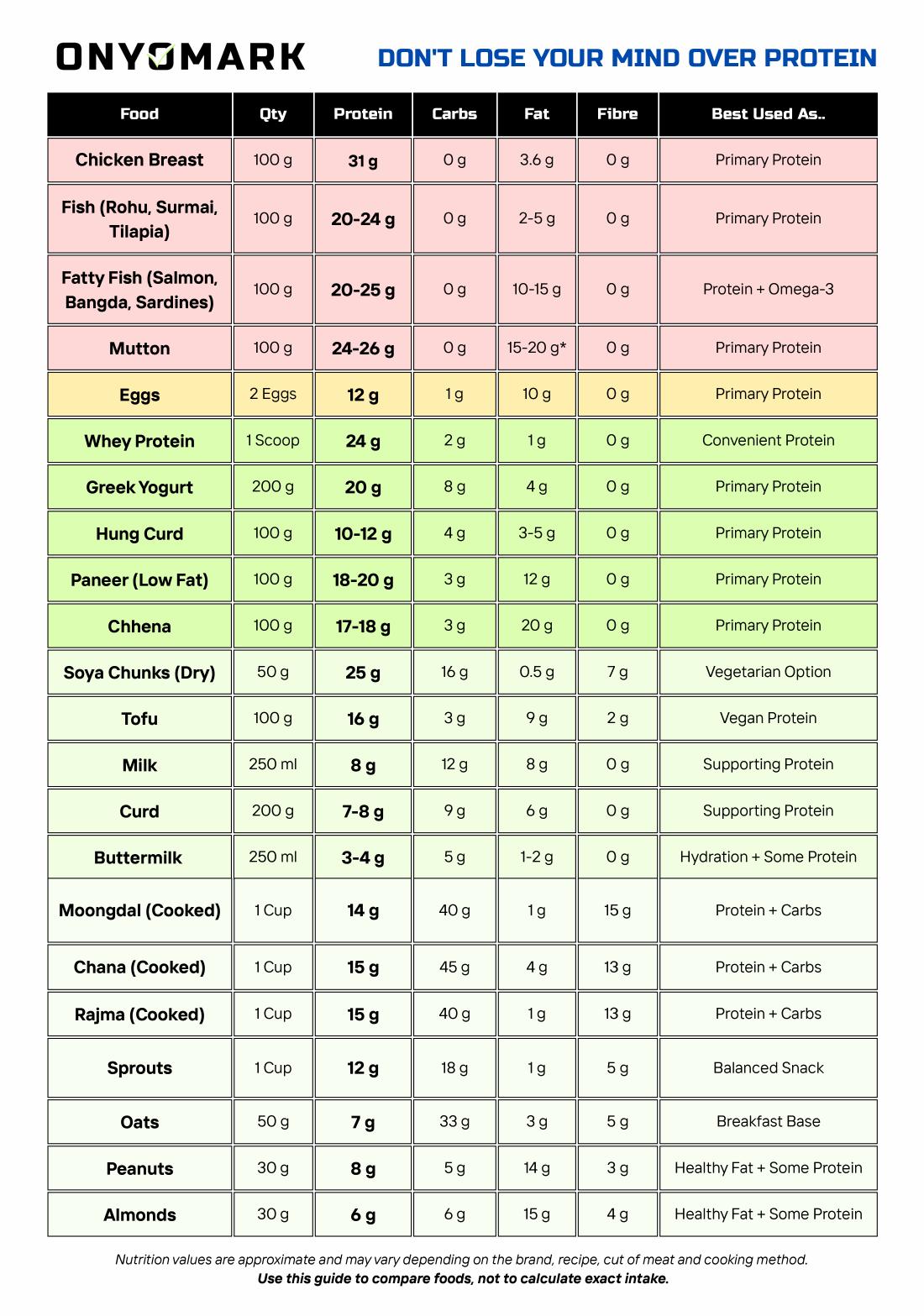
Don't Lose Your Mind Over Protein
How to make protein a daily habit without turning your entire diet upside down. A calm, evidence-based guide to eating enough protein for fat loss and muscle — one meal at a time.

The Complete Fitness Guide for Busy Indian Working Couples
An honest, evidence-based guide for working couples in India who want to get fit without turning their life upside down. Practical routines, nutrition, and habits that actually last.